


Equivariant cohomology
In mathematics, equivariant cohomology (or Borel cohomology) is a cohomology theory from algebraic topology which applies to topological spaces with a group action. It can be viewed as a common generalization of group cohomology and an ordinary cohomology theory.
If acts freely, then the equivariant cohomology ring is just the singular cohomology ring of the quotient space . In particular, if is the trivial group, then the equivariant cohomology ring is the ordinary cohomology ring of . If is contractible, it reduces to the cohomology ring of the classifying space (that is, the group cohomology of when is finite.)


Definitions
[edit]Let be a topological space, with a (left) action by a group [clarification needed]. Let be a contractible space with a free (right) action by the same group. Define to be the quotient space , where the equivalence relation identifies with for all . The equivariant cohomology ring of (with respect to the group ) is then defined as the singular cohomology ring of this space:[1]The space is known as the Borel construction, or homotopy quotient. Projection onto the first factor gives it the structure of a fibre bundle over the classifying space . This is the associated -bundle obtained from the action of on and the principal bundle . The bundle is called the Borel fibration.


The group cohomology ring of can be recovered by taking to be a point, as in this case the homotopy quotient is just the classifying space of . If acts freely on , then the canonical map is a homotopy equivalence and so one gets


It is also possible to define the equivariant cohomology of with coefficients in a -module A; these are abelian groups. This construction is the analogue of cohomology with local coefficients.

If X is a manifold, G a compact Lie group and coefficients are taken in the field of real numbers or the field of complex numbers (the most typical situation), then the above cohomology may be computed using the so-called Cartan model (see equivariant differential forms.)
The construction should not be confused with other cohomology theories, such as Bredon cohomology or the cohomology of invariant differential forms: if G is a compact Lie group, then, by the averaging argument[citation needed], any form may be made invariant; thus, cohomology of invariant differential forms does not yield new information.
Koszul duality is known to hold between equivariant cohomology and ordinary cohomology.
Relation with groupoid cohomology
[edit]For a Lie groupoid equivariant cohomology of a smooth manifold[2] is a special example of the groupoid cohomology of a Lie groupoid. This is because given a -space for a compact Lie group , there is an associated groupoid
![{\displaystyle {\mathfrak {X}}=[X_{1}\rightrightarrows X_{0}]}](https://wikimedia.org/api/rest_v1/media/math/render/svg/e1b20d4348bc7d593fb6b8cc32d3259e026a2511)
![{\displaystyle {\mathfrak {X}}_{G}=[G\times X\rightrightarrows X]}](https://wikimedia.org/api/rest_v1/media/math/render/svg/2162402a18c32dd969cfaf2b2589b71d021b96b8)
whose equivariant cohomology groups can be computed using the Cartan complex which is the totalization of the de-Rham double complex of the groupoid. The terms in the Cartan complex are


where is the symmetric algebra of the dual Lie algebra from the Lie group , and corresponds to the -invariant forms. This is a particularly useful tool for computing the cohomology of for a compact Lie group since this can be computed as the cohomology of


![{\displaystyle [G\rightrightarrows *]}](https://wikimedia.org/api/rest_v1/media/math/render/svg/44c714ec0f3d2bcf66be3bee74dad70ee47fb752)
where the action is trivial on a point. Then,
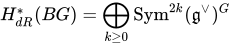
For example,
![{\displaystyle {\begin{aligned}H_{dR}^{*}(BU(1))&=\bigoplus _{k=0}{\text{Sym}}^{2k}(\mathbb {R} ^{\vee })\\&\cong \mathbb {R} [t]\\&{\text{ where }}\deg(t)=2\end{aligned}}}](https://wikimedia.org/api/rest_v1/media/math/render/svg/41d0ad61087e0a5aed739418fa17adefd58165f5)
since the -action on the dual Lie algebra is trivial.

An example of a homotopy quotient
[edit]The following example is Proposition 1 of [1].
Let X be a complex projective algebraic curve. We identify X as a topological space with the set of the complex points , which is a compact Riemann surface. Let G be a complex simply connected semisimple Lie group. Then any principal G-bundle on X is isomorphic to a trivial bundle, since the classifying space is 2-connected and X has real dimension 2. Fix some smooth G-bundle on X. Then any principal G-bundle on is isomorphic to . In other words, the set of all isomorphism classes of pairs consisting of a principal G-bundle on X and a complex-analytic structure on it can be identified with the set of complex-analytic structures on or equivalently the set of holomorphic connections on X (since connections are integrable for dimension reason). is an infinite-dimensional complex affine space and is therefore contractible.


Let be the group of all automorphisms of (i.e., gauge group.) Then the homotopy quotient of by classifies complex-analytic (or equivalently algebraic) principal G-bundles on X; i.e., it is precisely the classifying space of the discrete group .


One can define the moduli stack of principal bundles as the quotient stack and then the homotopy quotient is, by definition, the homotopy type of .

![{\displaystyle [\Omega /{\mathcal {G}}]}](https://wikimedia.org/api/rest_v1/media/math/render/svg/b8b344ae9bd56994f3a147836c70c78f7ab5d06d)
Equivariant characteristic classes
[edit]Let E be an equivariant vector bundle on a G-manifold M. It gives rise to a vector bundle on the homotopy quotient so that it pulls-back to the bundle over . An equivariant characteristic class of E is then an ordinary characteristic class of , which is an element of the completion of the cohomology ring . (In order to apply Chern–Weil theory, one uses a finite-dimensional approximation of EG.)


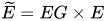


Alternatively, one can first define an equivariant Chern class and then define other characteristic classes as invariant polynomials of Chern classes as in the ordinary case; for example, the equivariant Todd class of an equivariant line bundle is the Todd function evaluated at the equivariant first Chern class of the bundle. (An equivariant Todd class of a line bundle is a power series (not a polynomial as in the non-equivariant case) in the equivariant first Chern class; hence, it belongs to the completion of the equivariant cohomology ring.)
In the non-equivariant case, the first Chern class can be viewed as a bijection between the set of all isomorphism classes of complex line bundles on a manifold M and [3] In the equivariant case, this translates to: the equivariant first Chern gives a bijection between the set of all isomorphism classes of equivariant complex line bundles and .


Localization theorem
[edit]![[icon]](/wiki/File:Wiki_letter_w_cropped.svg?lang=en) | This section needs expansion. You can help by adding to it. (April 2014) |
The localization theorem is one of the most powerful tools in equivariant cohomology.
See also
[edit]- Equivariant differential form
- Kirwan map
- Localization formula for equivariant cohomology
- GKM variety
- Bredon cohomology
Notes
[edit]- ^ Anderson, David; Fulton, William (2023). Equivariant Cohomology in Algebraic Geometry. Cambridge University Press. p. 1. ISBN 9781009349994.
- ^ Behrend 2004
- ^ using Čech cohomology and the isomorphism given by the exponential map.

References
[edit]- Atiyah, Michael; Bott, Raoul (1984), "The moment map and equivariant cohomology", Topology, 23: 1–28, doi:10.1016/0040-9383(84)90021-1
- Brion, M. (1998). "Equivariant cohomology and equivariant intersection theory" (PDF). Representation Theories and Algebraic Geometry. Nato ASI Series. Vol. 514. Springer. pp. 1–37. arXiv:math/9802063. doi:10.1007/978-94-015-9131-7_1. ISBN 978-94-015-9131-7. S2CID 14961018.
- Goresky, Mark; Kottwitz, Robert; MacPherson, Robert (1998), "Equivariant cohomology, Koszul duality, and the localization theorem", Inventiones Mathematicae, 131: 25–83, CiteSeerX 10.1.1.42.6450, doi:10.1007/s002220050197, S2CID 6006856
- Hsiang, Wu-Yi (1975). Cohomology Theory of Topological Transformation Groups. Springer. doi:10.1007/978-3-642-66052-8. ISBN 978-3-642-66052-8.
- Tu, Loring W. (March 2011). "What Is . . . Equivariant Cohomology?" (PDF). Notices of the American Mathematical Society. 58 (3): 423–6. arXiv:1305.4293.
Relation to stacks
[edit]- Behrend, K. (2004). "Cohomology of stacks" (PDF). Intersection theory and moduli. ICTP Lecture Notes. Vol. 19. pp. 249–294. ISBN 9789295003286. PDF page 10 has the main result with examples.
Further reading
[edit]- Guillemin, V.W.; Sternberg, S. (1999). Supersymmetry and equivariant de Rham theory. Springer. doi:10.1007/978-3-662-03992-2. ISBN 978-3-662-03992-2.
- Vergne, M.; Paycha, S. (1998). "Cohomologie équivariante et théoreme de Stokes" (PDF). Département de Mathématiques, Université Blaise Pascal.
External links
[edit]- Meinrenken, E. (2006), "Equivariant cohomology and the Cartan model" (PDF), Encyclopedia of mathematical physics, pp. 242–250, ISBN 978-0-12-512666-3 — Excellent survey article describing the basics of the theory and the main important theorems
- "Equivariant cohomology", Encyclopedia of Mathematics, EMS Press, 2001 [1994]
- Young-Hoon Kiem (2008). "Introduction to equivariant cohomology theory" (PDF). Seoul National University.
- What is the equivariant cohomology of a group acting on itself by conjugation?