


Road signs in Canada
 | This article needs additional citations for verification. (February 2015) |
Road signs in Canada may conform to the Manual of Uniform Traffic Control Devices for Canada (MUTCDC)[1][2] by the Transportation Association of Canada (TAC)[3] for use by Canadian jurisdictions. Although it serves a similar role to the MUTCD from the US Federal Highway Administration, it has been independently developed and has a number of key differences with its American counterpart, most notably the inclusion of bilingual (English/French) signage for jurisdictions such as New Brunswick with significant francophone populations, as well as a heavier reliance on symbols rather than text legends.
Language
[edit]In Canada most of the road signs are written in English or French.
"All federal government-only signs and signs for highway use must be bilingual regardless of whether mandated by local, provincial or territorial language requirements," except for some places.[4]
In Nunavut the four official languages (including Inuktitut and Inuinnaqtun, also French and English) must be used.[4] Through Sea to Sky Highway (BC 99) one can see the places are labelled in Squamish names e.g. "K'emk'emeláy" (Vancouver).[5]
Stop sign
[edit]

Under federal jurisdiction, the Office of the Commissioner of Official Languages has ruled the word stop to be an exclusively English term when used for stop signs.[6] Accordingly, to comply with the Official Languages Act, only bilingual stop signs with both English and French (i.e.: stop and arrêt) are used on federally-regulated sites such as airports and entry points run by Canada Customs.
Canada is the only country which uses arrêt instead of stop in the francophone world.[7]
In Quebec, although all road signs must be in French legally, modern stop signs can be found with either arrêt or stop.[8] Both words are considered valid French words by the Office québécois de la langue française (OQLF), a stance held by the agency since 1927.[9] In practice, however, it can be empirically observed (for instance, with Google Street View) that arrêt predominates in French-speaking areas (i.e., most of the geographic extent of Quebec), while stop can be found in majority English-speaking areas such as Montreal's West Island suburbs. At the time of the debates surrounding the adoption of the Charter of the French Language ("Bill 101") in 1977, the usage of stop on the older dual-word signs was considered to be English and therefore controversial; some signs were occasionally vandalized with red spray paint to turn the word stop into "101".[10]
Canadian road signs
[edit]
The following are samples of Canadian road signs:
Gallery of stop signs
[edit] | This page is a candidate to be copied to Wikimedia Commons. If the page can be re-written into an encyclopedic article, please do so and remove this message. |
-
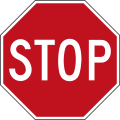 Stop (English)
 -
 Stop (French)
 -
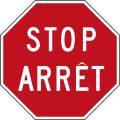 Stop (English and French)
 -
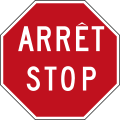 Stop (French and English)
 -
 Stop (Inuktitut and English)
 -
 Stop (Cree)
 -
 Stop (Cree and French)
 -
 Stop (Cree and English and French)


.svg?lang=en)
.svg?lang=en)
Gallery of other signs
[edit]Alphanumeric reference IDs from the Manual of Uniform Traffic Control Devices for Canada are included.
-
 RA-2
RA-2
Yield -
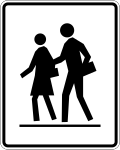 RA-3
RA-3
School crossing -
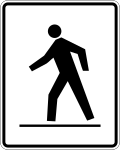 RA-4
RA-4
Pedestrian crossing -
 RA-5
RA-5
Overhead pedestrian crossing -
 RA-6
RA-6
Railway crossing -
 RB-1
RB-1
Maximum speed limit (federal standard)
(ex: 50 km/h) -
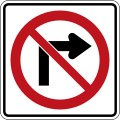 RB-11L
No right turn -
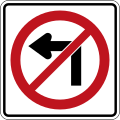 RB-11R
No left turn -
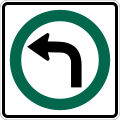 RB-14L
Left turn required -
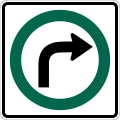 RB-14R
Right turn required -
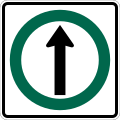 RB-15
RB-15
Must proceed straight only, turns prohibited -
 RB-22
RB-22
Wrong way -
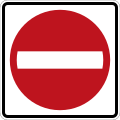 RB-23
RB-23
No entry -
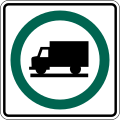 RB-61
RB-61
Truck route -
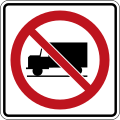 RB-62
RB-62
No trucks -
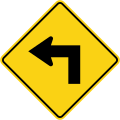 WA-1L
WA-1L
Turn to left -
 WA-1R
WA-1R
Turn to right -
 WA-3L
WA-3L
Curve to left -
 WA-3R
WA-3R
Curve to right -
 WA-4L
WA-4L
Reverse turn to left -
 WA-4R
WA-4R
Reverse turn to right -
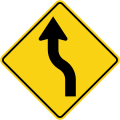 WA-5L
WA-5L
Reverse curve to left -
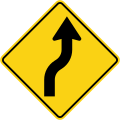 WA-5R
WA-5R
Reverse curve to right -
 WA-6L
WA-6L
Multiple curves to left -
 WA-6R
WA-6R
Multiple curves to right -
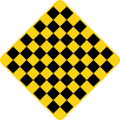 WA-8
WA-8
End of road -
 WA-8
WA-8
Sharp curve marker -
 WA-8
WA-8
T-junction marker -
 WA-10
WA-10
Advisory speed limit -
 WA-11
WA-11
Crossroad -
 WA-13
WA-13
Side road intersection -
 WA-14
WA-14
T-junction -
 WA-15
WA-15
Y-junction -
 WA-16
WA-16
Merging traffic -
 WA-18
WA-18
Railway crossing ahead -
 WA-18L
Skewed railway crossing ahead -
 WA-18R
Skewed railway crossing ahead -
 WA-19
WA-19
Railway crossing on side road ahead -
 WA-20
WA-20
Railway crossing on side road ahead -
 WA-21
WA-21
Steep descent -
 WA-23
WA-23
Road narrows ahead -
 WA-24
WA-24
Narrow bridge ahead -
 WA-26
WA-26
Height restriction ahead -
 WA-27
WA-27
Height restriction marker -
 WA-31
WA-31
Divided highway begins -
 WA-32
WA-32
Divided highway ends -
 WA-33L
Left lane ends -
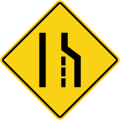 WA-33R
Right lane ends -
 WA-35
WA-35
Added lane -
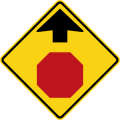 WB-1
WB-1
Stop sign ahead -
 WB-2
WB-2
Yield sign ahead -
 WB-3
WB-3
Two-way traffic ahead -
 WC-1
WC-1
School zone -
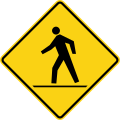 WC-2
WC-2
Pedestrian crossing ahead -
 WC-3
WC-3
Playground -
 WC-8L
WC-8L
Heavy vehicles entering from left -
 WC-8R
WC-8R
Heavy vehicles entering from right -
 WC-14
WC-14
Moose crossing -
 WC-22
WC-22
Animal-drawn vehicle crossing


British Columbia road signs
[edit]British Columbia maintains its own equivalent standard to the Canadian and US MUTCD, the "Manual of Standard Traffic Signs and Pavement Markings".
-
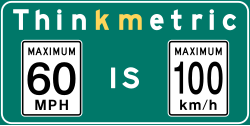 This sign is posted after the Canada–US border to remind US drivers that Canada uses the metric system.
The imperial speed limit (left) is a BC-style sign, rather than an MUTCD-standard one as would be used in the US. -
 Stop
Stop -
 Yield
Yield -
 Maximum speed limit
 -
 Do not enter
 -
 Wrong way
 -
 No left turn
 -
 No right turn
 -
 Left turn required
 -
 Right turn required
 -
 Straight ahead only
 -
 No right turn on red signal
 -
 No trucks
 -
 Truck route
 -
 School zone
 -
 School zone speed limit
 -
 Pedestrian crossing ahead
 -
 Pedestrian crossing
 -
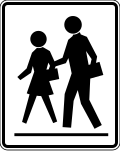 School crossing
 -
 Playground
 -
 Curve to left
 -
 Curve to right
 -
 Turn to left
 -
 Turn to right
 -
 Reverse curve to left
 -
 Reverse curve to right
 -
 Multiple curves to left
 -
 Multiple curves to right
 -
 Crossroad
 -
 Side road intersection
 -
 T-junction
 -
 Y-junction
 -
 Railway crossing ahead
 -
 Skewed railway crossing ahead
 -
 Skewed railway crossing ahead
 -
 Railway crossing on side road ahead
 -
 Railway crossing on side road ahead
 -
 Stop sign ahead
 -
 End of road
 -
 Sharp curve marker
 -
 T-junction marker
 -
 Height restriction ahead
 -
 Height restriction marker
 -
 Two-way traffic ahead
 -
 Advisory speed limit
 -
 Road narrows ahead
 -
 Steep descent
 -
 Added lane
 -
 Merging traffic
 -
 Divided highway ends
 -
 Narrow bridge ahead
 -
 Left lane ends
 -
 Right lane ends
 -
 Moose crossing


Ontario road signs
[edit]The Ministry of Transportation of Ontario (MTO) also has historically used its own MUTCD which bore many similarities to the TAC MUTCDC. However, as of approximately 2000, MTO has been developing the Ontario Traffic Manual (OTM), a series of smaller volumes each covering different aspects of traffic control (e.g., sign design principles).
Sign classification
[edit]The Ontario Traffic Manual Committee categorises all road signs into two main categories: highway and non-highway sign types. Signs are then sub-categorised into two additional groups: urban and rural.[11]
Examples of Ontario regulatory and warning road signs
[edit]-
 A blue metric reminder signage used in Ontario, Canada is seen near the US borders.
 -
 Stop
Stop -
 Yield
Yield -
 Pedestrian crossing
 -
Maximum speed limit
-
 School zone speed limit
 -
 No left turn
 -
 No right turn
 -
 No right turn or straight ahead
 -
 No left turn or straight ahead
 -
 No turns
 -
 Do not enter
 -
 Do not enter, wrong way
 -
 Truck route
 -
 No trucks
 -
 Turn to left
 -
 Turn to right
 -
 Curve to left
 -
 Curve to right
 -
 Reverse turn to left
 -
 Reverse turn to right
 -
 Reverse curve to left
 -
 Reverse curve to right
 -
 Multiple curves to left
 -
 Multiple curves to right
 -
 End of road
 -
 Sharp curve marker
 -
 T-junction marker
 -
 Crossroad
 -
 Crossroad with minor road
 -
 Side road intersection
 -
 Side road intersection with minor road
 -
 T-junction
 -
 Y-junction
 -
 Y-junction on left
 -
 Y-junction on right
 -
 Merging traffic
 -
 Steep descent
 -
 Left lane ends
 -
 Right lane ends
 -
 Narrow bridge ahead
 -
 Height restriction ahead
 -
 Height restriction marker
 -
 Road narrows ahead
 -
 Advisory speed limit
 -
 Divided highway begins
 -
 Divided highway ends
 -
 Stop sign ahead
 -
 Two-way traffic ahead
 -
 School zone
 -
 School crossing
 -
 Playground
 -
 Railway crossing ahead
 -
 Pedestrian crossing ahead
 -
 Heavy vehicles entering from left
 -
 Heavy vehicles entering from right
 -
 Moose crossing
 -
 Animal-drawn vehicle crossing


.svg?lang=en)


Quebec road signs
[edit]The following are samples of Quebec road signs.[12][13][14] A notable difference between Quebec road signs and those of the rest of Canada is Quebec's use of a white chevron on a red background to mark road alignment around a curve, whereas the remainder of the country employs a black chevron on a yellow background.
Quebec gallery
[edit] | This page is a candidate to be copied to Wikimedia Commons. If the page can be re-written into an encyclopedic article, please do so and remove this message. |
-
 The logo for Le ministère des Transports et de la Mobilité durable (English: Ministry of Transport and Sustainable Mobility).
 -
 Metric signage reminder in Quebec, posted near US border and at major airports
The imperial speed limit (left) is a Quebec-style sign, rather than an MUTCD-standard one as would be used in the US -
 Arrêt (Translation: STOP)
 -
 Yield sign
 -
 Do not enter
 -
 Maximum speed (50 km/h)
 -
 Straight ahead only
 -
 Left turn required
 -
 Right turn required
 -
 No left turn
 -
 No right turn
 -
 No right turn on red signal
 -
 Truck route
 -
 No trucks
 -
 School crossing
 -
 Pedestrian crossing
 -
 Stop ahead
 -
 Two-way traffic ahead
 -
 Divided highway begins
 -
 Divided highway ends
 -
 Turn to left
 -
 Turn to right
 -
 Curve to left
 -
 Curve to right
 -
 Reverse turn to right
 -
 Reverse turn to left
 -
 Reverse curve to left
 -
 Reverse curve to right
 -
 Multiple curves to left
 -
 Multiple curves to right
 -
 Advisory speed limit
 -
 Merging traffic
 -
 Added lane
 -
 Crossroad
 -
 T-junction
 -
 Side road intersection
 -
 Y-junction
 -
 Railway crossing ahead
 -
 Skewed railway crossing ahead
 -
 Skewed railway crossing ahead
 -
 Railway crossing on side road ahead
 -
 Height restriction ahead
 -
 Height restriction marker
 -
 Narrow bridge ahead
 -
 Road narrows ahead
 -
 Steep descent
 -
 School zone
 -
 Pedestrian crossing ahead
 -
 Playground
 -
 Moose crossing
 -
 End of road


Retired signs
[edit]These signs have been superseded but can still be seen in some places.
-
 Stop through highway (Ontario) (1955)
 -
 Yield (Ontario) (1955)
 -
 Yield (Ontario) (1962)
 -
 School crossing (Blue on white) (Ontario) (1955)
 -
 School crossing (White on blue) (Ontario) (1955)
 -
 Railway crossing (Ontario) (1955)
 -
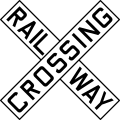 Railway crossing (1960-1970's)
 -
 Railway crossing (1970's-1980's)
 -
 Speed limit (Ontario) (1955)
 -
 Maximum speed limit (Ontario) (1960)
 -
 Suburban district speed limit (Ontario) (1960)
 -
 Turn to left (Ontario) (1955)
 -
 Turn to right (Ontario) (1955)
 -
 Curve to left (Ontario) (1955)
 -
 Curve to right (Ontario) (1955)
 -
 Reverse curve to left (Ontario) (1955)
 -
 Reverse curve to right (Ontario) (1955)
 -
 T-junction (Ontario) (1955)
 -
 Y-junction on left (Ontario) (1955)
 -
 Y-junction on right (Ontario) (1955)
 -
 Railway crossing ahead (Ontario) (1955)
 -
 Railway crossing ahead (1968-1975)
 -
 Stop sign ahead (Ontario) (1968)
 -
 School ahead (Ontario) (Blue on white) (1955)
 -
 School ahead (Ontario) (White on blue) (1955)
 -
 School zone (Ontario) (1960)
 -
 School zone (1960–1982)
 -
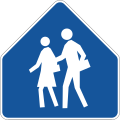 School zone (1982–2007)
 -
 School zone speed limit (Ontario) (1960)


.svg?lang=en)
.svg?lang=en)

_(old).svg?lang=en)
.svg?lang=en)


.svg?lang=en)

.svg?lang=en)
.svg?lang=en)

.svg?lang=en)
.svg?lang=en)

See also
[edit]- Comparison of traffic signs in English-speaking countries
- Crosswalks in North America
- Glossary of road transport terms
- Road signs in the United States
- Traffic sign
- Warning sign
References
[edit]- ^ MUTCDC
- ^ Manual of Uniform Traffic Control Devices for Canada (Fifth ed.). Ottawa: Transportation Association of Canada. 2014. PTM-MUTCD14-E (English ed.).
- ^ TAC
- ^ a b "Infrastructure Project Signage Guidelines Annex D – Mandatory Bilingual Signage Use". Housing, Infrastructure and Communities Canada. 2017-02-13.
- ^ Sterritt, Angela. "Road signs along the Sea to Sky Highway offer insight into the history of the Sḵwx̱wú7mesh people". CBC.
- ^ Desjardins, Anaïs. "Le mot «STOP» sur un panneau d'arrêt est de l'anglais, selon le Commissariat aux langues officielles". Le Devoir. Retrieved 21 August 2025.
- ^ "Canada".
- ^ "Répertoire des dispositifs de signalisation routière du Québec". Transports Québec. Archived from the original on 2012-02-22. Retrieved 2012-03-11.
- ^ Office québécois de la langue française, granddictionnaire.com. No direct link: look up panneau STOP under Recherche and then click on either route or transport under the resulting Index listing
- ^ Photo by Flickr.com user "imagesdistributioncanada"
- ^ Ontario Traffic Manual - Book 2 - Sign Design, Fabrication and Patterns. March 2005.
- ^ Tous les dispositifs de signalisation
- ^ Road_signs_of_Quebec
- ^ Road_signs_of_Quebec
External links
[edit]- Government of Quebec traffic control devices library - Extensive list of all road signs and signals from the Quebec Transport Ministry (in English and French)
- Road Signs in Ontario, from the Ontario Ministry of Transportation.
- Traffic Signs & Pavement Marking, from the British Columbia Ministry of Transportation and Infrastructure