


Portal:Politics

| Main | Topics and categories | Tasks and projects |
The Politics portal
.jpg?lang=en)
Politics is the set of activities that are associated with making decisions in groups, or other forms of power relations among individuals, such as the distribution of status or resources. The branch of social science that studies politics and government is referred to as political science.
Politics may be used positively in the context of a "political solution" which is compromising and non-violent, or descriptively as "the art or science of government", but the word often also carries a negative connotation. The concept has been defined in various ways, and different approaches have fundamentally differing views on whether it should be used extensively or in a limited way, empirically or normatively, and on whether conflict or co-operation is more essential to it.
A variety of methods are deployed in politics, which include promoting one's own political views among people, negotiation with other political subjects, making laws, and exercising internal and external force, including warfare against adversaries. Politics is exercised on a wide range of social levels, from clans and tribes of traditional societies, through modern local governments, companies and institutions up to sovereign states, to the international level.
In modern states, people often form political parties to represent their ideas. Members of a party often agree to take the same position on many issues and agree to support the same changes to law and the same leaders. An election is usually a competition between different parties.
A political system is a framework which defines acceptable political methods within a society. The history of political thought can be traced back to early antiquity, with seminal works such as Plato's Republic, Aristotle's Politics, Confucius's political manuscripts and Chanakya's Arthashastra. (Full article...)
Selected article
The Liberal Movement was a minor South Australian political party in the 1970s. Stemming from discontent within the ranks of the Liberal and Country League, it was organised in 1972 by former premier Steele Hall as an internal group in response to a perceived resistance to sought reform within its parent. A year later, when tensions heightened between the LCL's conservative wing and the LM, it was established in its own right as a progressive liberal party. When still part of the league, it had eleven parliamentarians; on its own, it was reduced to three. In the federal election of 1974, it succeeded in having Hall elected to the Australian Senate with a primary vote of 10 per cent in South Australia. It built upon this in the 1975 state election, gaining almost a fifth of the total vote and an additional member. However, the non-Labor parties narrowly failed to dislodge the incumbent Dunstan Labor government. That result, together with internal weaknesses, led in 1976 to the LM's being re-absorbed into the LCL, which by then had become the South Australian division of the Liberal Party of Australia. The LM and its successor parties gave voice to what is termed "small-l liberalism" in Australia.
Featured picture

Parliament House is the meeting facility of the Parliament of Australia located in Canberra, the capital of Australia. The building was designed by Mitchell/Giurgola Architects and opened on 9 May 1988 by Elizabeth II, Queen of Australia. At the time of the construction, it was the most expensive building in the world at more than A$1.1 billion.
 Featured lists -

-
 Until the 18th century, Bombay consisted of seven islands separated by shallow sea. These seven islands were part of a larger archipelago in the Arabian sea, off the western coast of India. The date of city's founding is unclear—historians trace back urban settlement to the late 17th century after the British secured the seven islands from the Portuguese to establish a secure base in the region. The islands provided the British with a sheltered harbour for trade, in addition to a relatively sequestered location that reduced the chances of land-based attacks. Over the next two centuries, the British dominated the region, first securing the archipelago from the Portuguese, and later defeating the Marathas to secure the hinterland.
Bombay Presidency was one of the three Presidencies of British India; the other two being Madras Presidency, and Bengal Presidency. It was in the centre-west of the Indian subcontinent on the Arabian Sea. It was bordered to the north-west, north, and north-east by Baluchistan province, Punjab province, and Rajputana Agency; to the east by Central India Agency, the Central Provinces and Berar and Hyderabad State; and to the south by Madras Presidency and Mysore State. The Presidency was established in the late 17th century and named after Bombay, the capital city and the island on which it was built. By 1906, the area under the jurisdiction of Bombay Presidency stretched from North Canara in the south to Sindh in the north, encompassing the now-Pakistani province of Sindh, some parts of the present-day state of Gujarat, northwestern part of Karnataka state, the British Aden protectorate in Yemen, and the western two-thirds of modern-day Maharashtra. (Full article...) -

2025 BJP CM History
The Bharatiya Janata Party (BJP) is one of the two major parties in the political system of the Republic of India, the other being the Indian National Congress (INC). As of 2015[update], it is the country's largest political party in terms of representation in the national parliament. Established in 1980, the BJP's platform is generally considered as the right-wing of the political spectrum. As of 20 February 2025[update], 55 BJP leaders have held the position of a chief minister out of which fourteen are incumbent.
A chief minister is the head of government of each of the twenty-eight states and two union territories (UTs) (Delhi and Puducherry). According to the Constitution of India, at the state-level, the governor is de jure head, but de facto executive authority rests with the chief minister. Following elections to the state legislative assembly, the governor usually invites the party (or coalition) with a majority of seats to form the government. The governor appoints the chief minister, whose council of ministers are collectively responsible to the assembly. The chief minister's term is usually for a maximum of five years, with the confidence of the assembly's confidence. There are no limits to the number of terms the chief minister can serve. (Full article...) -
A total of 41 counties (Romanian: județe), along with the municipality of Bucharest, constitute the official administrative divisions of Romania. They represent the country's NUTS-3 (Nomenclature of Territorial Units for Statistics – Level 3) statistical subdivisions within the European Union and each of them serves as the local level of government within its borders. Most counties are named after a major river, while some are named after notable cities within them, such as the county seat.
The earliest organization into județe of the Principalities of Wallachia and Moldavia (where they were termed ținuturi) dates back to at least the late 14th century. For most of the time since modern Romania was formed in 1859, the administrative division system has been similar to that of the French departments. The system has since changed several times and the number of counties has varied over time, from the 71 județe that existed before World War II to only 39 after 1968. The current format has largely been in place since 1968 as only small changes have been made since then, the last of which was in 1997. (Full article...) -

The leader of the Official Opposition (French: chef de l'Opposition officielle) is the member of Parliament (MP) who leads the Official Opposition in Canada. This is typically the leader of the party possessing the most seats in the House of Commons that is neither the governing party nor part of a governing coalition.
Pierre Poilievre, MP for Battle River—Crowfoot, has been the leader of the Official Opposition since August 2025. Poilievre previously served in the role from September 2022 to April 2025, when he lost his seat in Carleton in the 2025 federal election. He was elected to his current seat in an August by-election, once again becoming leader of the Opposition. (Full article...) -

The prime minister of Pakistan is the head of the Government of Pakistan. The prime minister is vested with the responsibility of running the administration through his appointed federal cabinet, formulating national and foreign policies to ensure the safeguard of the interests of the nation and its people through the Council of Common Interests as well as making the decision to call nationwide general elections for the bicameral Parliament of Pakistan.
Since 1947, Pakistan has had 20 prime ministers, aside from the appointed caretaker prime ministers who were only mandated to oversee the system until the election process was finished. In Pakistan's parliamentary system, the prime minister is sworn in by the president and usually is the chairman or the president of the party or coalition that has a majority in the National Assembly– the lower house of Pakistan Parliament. (Full article...) -
The governor of New Jersey is the head of government of New Jersey and the commander-in-chief of the state's military forces. The governor has a duty to enforce state laws and the power to either approve or veto bills passed by the New Jersey Legislature, to convene the legislature, and to grant pardons, except in cases of treason or impeachment.
The first New Jersey State Constitution, ratified in 1776, provided that a governor be elected annually by the state legislature, the members of which were selected by the several counties. Under this constitution, the governor was president of the upper house of the legislature, then called the Legislative Council. The 1844 constitution provided for a popular vote to elect the governor, who no longer presided over the upper house of the legislature, now called the Senate. The 1844 constitution also lengthened the governor's term to three years, set to start on the third Tuesday in January following an election, and barred governors from succeeding themselves. The 1947 constitution extended terms to four years, and limits governors from being elected to more than two consecutive terms, though they can run again after a third term has passed. Joseph Bloomfield, Peter Dumont Vroom, Daniel Haines, Joel Parker, Leon Abbett, and Walter Evans Edge each served two non-consecutive stints as governor while A. Harry Moore served three non-consecutive stints. Foster McGowan Voorhees, James Fairman Fielder, and Richard Codey each served two non-consecutive stints, one as acting governor and one as official governor. (Full article...) -
The governor of Connecticut is the head of government of Connecticut, and the commander-in-chief of the state's military forces. The governor has a duty to enforce state laws, and the power to either approve or veto bills passed by the Connecticut General Assembly and to convene the legislature. Unusual among governors, the governor of Connecticut has no power to pardon. The governor of Connecticut is automatically a member of the state's Bonding Commission. He is an ex-officio member of the board of trustees of the University of Connecticut and Yale University.
There have been 69 post-Revolution governors of the state, serving 73 distinct spans in office. Four have served non-consecutive terms: Henry W. Edwards, James E. English, Marshall Jewell, and Raymond E. Baldwin. The longest terms in office were in the state's early years, when four governors were elected to nine or more one-year terms. The longest was that of the first governor, Jonathan Trumbull, who served over 14 years, but 7 of those as colonial governor; the longest-serving state governor — with no other position included in the term — was his son, Jonathan Trumbull Jr., who served over 11 years. The shortest term was that of Hiram Bingham III, who served only one day before resigning to take an elected seat in the United States Senate. Additionally, Lowell Weicker is noted for a rare third party win in American politics, having been elected to a term in 1990 representing A Connecticut Party. (Full article...) -
The Mayor of Pichilemu is an elected politician who is the head of the executive branch of government of the commune of Pichilemu, Libertador General Bernardo O'Higgins Region, Chile. The mayor presides over the local city council, composed of six members, and serves as the civic representative of the commune. The mayor is popularly elected in a municipal election, by simple majority. The office is held for a four-year term without term limits.
Forty different individuals, including acting mayors, have held the office of mayor since the commune of Pichilemu was created in December 1891. José María Caro Martínez, elected in 1894, was the inaugural mayor of the commune, and served for almost four consecutive terms, interrupted by his resignation in 1905. The current mayor is independent Cristian Pozo Parraguez, who was elected in May 2021 and took office on that 28 June. (Full article...) -
The Supreme Court of Canada is the highest court of Canada. It was established by the Parliament of Canada through the Supreme and Exchequer Court Act of 1875. Since 1949, the Court has been the final court of appeal in the Canadian justice system. Originally composed of six justices (the Chief Justice of Canada and five puisne justices), the Court was expanded to seven justices by the creation of an additional puisne justice position in 1927, and then to nine justices by the creation of two more puisne justice positions in 1949.
The justices are appointed by the governor general on the advice of the prime minister. When a chief justice leaves office, the vacancy is traditionally filled by elevating an incumbent puisne justice to the position, which requires a separate appointment process. The first six justices of the Court were all appointed in 1875 by Governor General the Earl of Dufferin, on the advice of Prime Minister Alexander Mackenzie. (Full article...) -

Máire Geoghegan-Quinn, who in 1979 became the first woman in an Irish cabinet since 1921
The Government of Ireland is the cabinet that exercises executive authority in the Republic of Ireland. Its ministers are collectively responsible for the Departments of State administered by the members of the Government.
As of 2025[update], twenty-three women have served as cabinet ministers in governments of the Republic of Ireland and its predecessors the Irish Free State (1922–1937) and the Irish Republic (1919–1922). After a 58-year gap between the first and second women ministers, there has been at least one woman in all cabinets since December 1982. No woman has ever been Taoiseach (prime minister), but four women have served as Tánaiste (deputy prime minister). (Full article...) -
The five counties of Hawaii on the Hawaiian Islands enjoy somewhat greater status than many counties on the United States mainland. Counties in Hawaii are the only legally constituted government bodies below that of the state. No formal level of government (such as city governments) exists below that of the county in Hawaii.
Unlike the other 49 states, Hawaii does not delegate educational responsibility to local school boards; public education is carried out by the Hawaii State Department of Education. Hawaiian counties collect property taxes and user fees in order to support road maintenance, community activities, parks (including life guards at beach parks), garbage collection, police (the state police force, called the Hawaii Department of Public Safety, is limited in scope), ambulance, and fire suppression services. (Full article...) -

The president of India is the head of state of the Republic of India and the supreme commander of the Indian Armed Forces. The president is referred to as the first citizen of India. Although vested with these powers by the Constitution of India, the position is largely a ceremonial one and executive powers are de facto exercised by the prime minister.
The president is elected by the Electoral College composed of elected members of the parliament houses, the Rajya Sabha and the Lok Sabha, and also members of the Vidhan Sabha, the state legislative assemblies. Presidents may remain in office for a tenure of five years, as stated by article 56, part V, of the Constitution of India. In the case where a president's term of office is terminated early or during the absence of the president, the vice president assumes office. By article 70 of part V, the parliament may decide how to discharge the functions of the president where this is not possible, or in any other unexpected contingency. (Full article...) -

David Eby has been premier of British Columbia since 2022.
The premier of British Columbia is the first minister for the Canadian province of British Columbia. The province was a British crown colony governed by the governors of British Columbia before joining Canadian Confederation in 1871. Since then, it has had a unicameral Westminster-style parliamentary government, in which the premier is the leader of the party that controls the most seats in the legislative assembly. The premier is British Columbia's head of government, and the king of Canada is its head of state and is represented by the lieutenant governor of British Columbia. The premier picks a cabinet from the elected members to form the Executive Council of British Columbia and presides over that body.
Members are first elected to the legislature during general elections. General elections must be conducted every four years from the date of the last election. An election may also take place if the governing party loses the confidence of the legislature by the defeat of a supply bill or tabling of a no-confidence motion. (Full article...) -
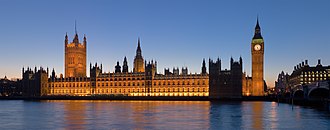
The Palace of Westminster, meeting place of the House of Commons and the House of Lords
This is a list of people who have addressed both Houses of the United Kingdom Parliament at the same time. Although English and later British monarchs have jointly addressed the House of Commons and the House of Lords on several occasions since the 16th century, the first foreign dignitary to do so was French President Albert Lebrun in March 1939. The list excludes the speeches given by (or on behalf of) the Sovereign at the State Opening of Parliament and at the close of each parliamentary session.
Only four people besides the reigning monarch at the time have addressed both Houses together on more than one occasion. Nelson Mandela addressed Members of the Commons and the Lords in 1993 and in 1996 as President of South Africa. Mikhail Gorbachev addressed the Houses as a secretary of the Communist Party of the Soviet Union and a foreign delegate of the Soviet Union in 1984 and again, in 1993, on behalf of the Inter-Parliamentary Union. Shimon Peres addressed the Houses as Prime Minister of Israel in 1986 and as President in 2008. Volodymyr Zelenskyy addressed the Houses as President of Ukraine, the first to address in the Chamber (albeit via remote video link from Ukraine), in 2022 during the Russian invasion of Ukraine. (Full article...) -

Districts (Sinhala: දිස්ත්රික්ක, romanized: Distrikka, Tamil: மாவட்டம், romanized: Māvaṭṭam) are the second level administrative divisions of Sri Lanka, preceded by provinces. Sri Lanka has 25 districts organized into 9 provinces. Districts are further divided into a number of divisional secretariats (commonly known as D.S. divisions), which are in turn subdivided into 14,022 grama niladhari divisions. There are 331 DS divisions in Sri Lanka.
Each district is administered under a district secretary, who is appointed by the central government. The main tasks of the district secretariat involve coordinating communications and activities of the central government and divisional secretariats. The district secretariat is also responsible for implementing and monitoring development projects at the district level and assisting lower-level subdivisions in their activities, as well as revenue collection and coordination of elections in the district. (Full article...)


.jpg?lang=en)


.jpg?lang=en)
,_signed_image_for_Walter_Nash_(NZ_Prime_Minister),_1958_(16017609534).jpg?lang=en)
_(cropped).png?lang=en)


Selected quote
Selected biography

John Robert Boyle KC (February 3, 1871 – February 15, 1936) was a Canadian politician and jurist who served as a Member of the Legislative Assembly of Alberta, a cabinet minister in the Government of Alberta, and a judge on the Supreme Court of Alberta. Born in Ontario, he came west and eventually settled in Edmonton, where he practiced law. After a brief stint on Edmonton's first city council, he was elected in Alberta's inaugural provincial election as a Liberal. During the Alberta and Great Waterways Railway scandal, he was a leader of the Liberal insurgency that forced Premier Alexander Cameron Rutherford from office.
Did you know (auto-generated) -

- ... that valence populism cannot be positioned on the left–right political spectrum?
- ... that Americans received nearly 15 billion political text messages in 2022?
- ... that one abolitionist said that William L. Breckinridge's anti-slavery views would "disqualify [him] from political usefulness"?
- ... that Pocatello mayor Les Purce was the first African-American political officeholder in Idaho?
- ... that Endah Subekti Kuntariningsih began her career in her current political party as a typist?
- ... that 42 years after Jilly Cooper's How to Stay Married was first published, she described it as "terribly politically incorrect"?
More did you know...

- ...that a logocracy is government through words?
- ...that the Jewish Socialist Workers Party in the Russian Empire mobilized 3,000 of its cadres in self-defense militias during 1906?
- ...that the liberal film company Brave New Films has produced full-length videos and paper advertisements in addition to the viral videos for which it is known?
- ...that the Zimbabwe Human Rights NGO Forum recorded over 1,200 violations of human rights in Zimbabwe by the law enforcement agencies from 2001 to September 2006?
- ...that the ideology of the Romanian National Renaissance Front has been described as "operetta fascism"?
- ...that in the 1984 Brown v. Hotel and Restaurant Employees case, the U.S. Supreme Court upheld a New Jersey gaming law requiring union leaders to be of good moral character?
- ...that co-founder of the Saudi Civil and Political Rights Association Mohammed al-Bejadi spent most of 2011 in prison?
- ...that in April 2009, Lim Hwee Hua became the first woman to be appointed a full Minister in Singapore's Cabinet?
In this month
- January 1, 1912 – The Republic of China was proclaimed.
- January 4, 2011 – Tunisian street vendor Mohamed Bouazizi dies after setting himself on fire a month earlier, sparking anti-government protests in Tunisia and later other Arab nations. These protests become known collectively as the Arab Spring.
- January 5, 1912 – Vladimir Lenin and the Bolshevik Party break away from the rest of the Russian Social Democratic Labour Party.
- January 12, 1729 – Edmund Burke was born, considered to be the philosophical founder of modern conservatism.
- January 25, 2006 – Hamas wins a victory in the Palestinian legislative election, taking 76 of the 132 seats.
News and Current events

- August 11: 4 local government areas in New South Wales, Australia locked down after COVID-19 case
- August 11: Australia: AstraZeneca vaccine access expanded by Victorian government
- August 1: Australia: Victorian lockdown lifted
- July 29: Tunisia's president dismisses prime minister, suspends parliament
- July 25: Australia: Wikinews interviews Reg Kidd, mayor of the City of Orange, about COVID-19 lockdown and local government
- July 23: South Australia enters week-long lockdown to contain COVID-19 Delta variant spread
- July 21: Technological University Dublin senior lecturer Dr Lorcan Sirr speaks to Wikinews on housing market in Ireland
- July 21: Three rural councils in New South Wales, Australia enter 7-day lockdown
- July 21: Australia: Victoria lockdown extended by a week with 85 active cases recorded
- July 15: California governor signs new state budget, eligible Californians to get stimulus payments
Topics and categories
General images
-

-
 Reformers like the American Joseph Keppler depicted the Senate as controlled by the giant moneybags, who represented the nation's financial trusts and monopolies. (from Political corruption)
 -
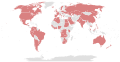 Countries with politicians, public officials or close associates implicated in the Panama Papers leak on April 15, 2016 (from Political corruption)
 -
 The Flag of the United Nations flying at United Nations Plaza in the Civic Center, San Francisco, California. The UN is one of the key organizations in the process of the political globalization. (from Political globalization)
 -
 World map with the concepts of Heartland and Rimland applied (from Geopolitics)
 -

-
 Ferdinand Marcos (pictured with his daughter Imee) was a Philippine dictator and kleptocrat. His regime was infamous for its corruption. (from Political corruption)
 -
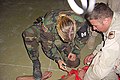 US Military Police officer restraining and sedating prisoner while a soldier holds him down (from Political corruption)
 -

-
 Detail from Corrupt Legislation (1896) by Elihu Vedder. Library of Congress Thomas Jefferson Building, Washington, D.C. (from Political corruption)
 -
 Sir Halford Mackinder's Heartland concept showing the situation of the "pivot area" established in the Theory of the Heartland. He later revised it to mark Northern Eurasia as a pivot while keeping area marked above as Heartland. (from Geopolitics)
 -
 This is the divide of the different political parties in Estonia where in the 2013 elections, over 133,000 people (roughly 21.2% of participating voters) voted over the Internet. The 2013 elections were also the first elections to allow vote verification with mobile devices. (from Politics and technology)
 -
-
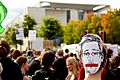 Protesters in support of American whistleblower Edward Snowden, Berlin, Germany, August 2014 (from Political corruption)
 -
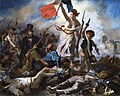 Eugène Delacroix's Liberty Leading the People (1830, Louvre), a painting created at a time where old and modern political philosophies came into violent conflict. (from History of political thought)
 -
 Division of the world according to Haushofer's pan-regions doctrine (from Geopolitics)
 -
 Malaysia's former Prime Minister Najib Razak was found guilty in the corruption trial over the multi-billion-dollar 1MDB scandal. He is currently serving his sentence in Kajang Prison. (from Political corruption)
 -
 Candlelight protest against South Korean President Park Geun-hye in Seoul, South Korea, January 2017 (from Political corruption)
 -
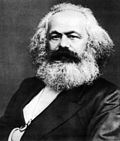 Karl Marx and his theory of Communism, developed with Friedrich Engels, proved to be one of the most influential political ideologies of the 20th century. (from History of political thought)
 -
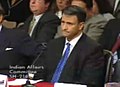 American lobbyist and businessman Jack Abramoff was at the center of an extensive corruption investigation. (from Political corruption)
 -
 A world map distinguishing countries of the world as federations (green) from unitary states (blue), a work of political science (from Political science)
 -
 Montenegro's former president Milo Đukanović is often described as having strong links to Montenegrin mafia. (from Political corruption)
 -
 Elizabeth Warren and Bernie Sanders campaigning for extended US Medicare coverage in 2017. (from Health politics)
 -

-
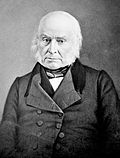 The sixth president of the United States, John Quincy Adams' "corrupt bargain" of 1824 is an example of patronage. (from Political corruption)
 -
 Savka Dabčević-Kučar, Croatian Spring participant; Europe's first female prime minister (from Civil and political rights)
 -
 Russia handing over the symbolic relay baton for the hosting rights of the 2022 FIFA World Cup to Qatar in June 2018 (from Political corruption)
 -
 The logo and slogan for change.org (from Politics and technology)
 -
 A memorial to the Great Famine (Ireland), a famine event in Ireland that faced elongated suffering from the UK's domestic policy failures at the time under the Prime Ministers Sir Robert Peel and Lord John Russell. (from Health politics)
,_%C3%A9crivain_et_homme_politique_-_P1679_-_Mus%C3%A9e_Carnavalet.jpg?lang=en)


_(2).jpg?lang=en)


.jpeg?lang=en)


.jpg?lang=en)


Related portals


Associated Wikimedia
The following Wikimedia Foundation sister projects provide more on this subject:
-
 Commons
Free media repository -
 Wikibooks
Free textbooks and manuals -
 Wikidata
Free knowledge base -
 Wikinews
Free-content news -
 Wikiquote
Collection of quotations -
 Wikisource
Free-content library -
 Wikiversity
Free learning tools -
 Wiktionary
Dictionary and thesaurus


