


Additive polynomial
 | This article relies largely or entirely on a single source. (May 2024) |
In mathematics, the additive polynomials are an important topic in classical algebraic number theory.
Definition
[edit]Let be a field of prime characteristic . A polynomial with coefficients in is called an additive polynomial, or a Frobenius polynomial, if


as polynomials in and . It is equivalent to assume that this equality holds for all and in some infinite field containing , such as its algebraic closure.


Occasionally absolutely additive is used for the condition above, and additive is used for the weaker condition that for all and in the field.[1] For infinite fields the conditions are equivalent,[2] but for finite fields they are not, and the weaker condition is the "wrong" as it does not behave well. For example, over a field of order any multiple of will satisfy for all and in the field, but will usually not be (absolutely) additive.


Examples
[edit]The polynomial is additive.[1] Indeed, for any and in the algebraic closure of one has by the binomial theorem

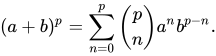
Since is prime, for all the binomial coefficient is divisible by , which implies that




as polynomials in and .[1]
Similarly all the polynomials of the form

are additive, where is a non-negative integer.[1]

The definition makes sense even if is a field of characteristic zero, but in this case the only additive polynomials are those of the form for some in .[citation needed]

The ring of additive polynomials
[edit]It is quite easy to prove that any linear combination of polynomials with coefficients in is also an additive polynomial.[1] An interesting question is whether there are other additive polynomials except these linear combinations. The answer is that these are the only ones.[3]

One can check that if and are additive polynomials, then so are and . These imply that the additive polynomials form a ring under polynomial addition and composition. This ring is denoted[4]

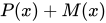


This ring is not commutative unless is the field (see modular arithmetic).[1] Indeed, consider the additive polynomials and for a coefficient in . For them to commute under composition, we must have

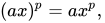
and hence . This is false for not a root of this equation, that is, for outside [1]


The fundamental theorem of additive polynomials
[edit]Let be a polynomial with coefficients in , and be the set of its roots. Assuming that the roots of are distinct (that is, is separable), then is additive if and only if the set forms a group with the field addition.[5]


See also
[edit]References
[edit]- ^ a b c d e f g Goss, David (1996), Basic Structures of Function Field Arithmetic, Berlin: Springer, p. 1, doi:10.1007/978-3-642-61480-4, ISBN 3-540-61087-1
- ^ Goss 1996, p. 2, Proposition 1.1.5.
- ^ Goss 1996, p. 3, Corollary 1.1.6
- ^ Equivalently, Goss 1996, p. 1 defines to be the ring generated by and then proves (p. 3) that it consists of all additive polynomials.
- ^ Goss 1996, p. 4, Theorem 1.2.1.
