Any number that is not an integer but is very close to one
Ed Pegg Jr. noted that the length d equals
(
61421
−
23
5831385
)
/
120
{\displaystyle {\sqrt {\left(61421-23{\sqrt {5831385}}\right)/\,120}}}
7
{\displaystyle 7}
7.0000000857
{\displaystyle 7.0000000857}
[ 1] In recreational mathematics , an almost integer (or near-integer ) is any number that is not an integer but is very close to one. Almost integers may be considered interesting when they arise in some context in which they are unexpected.
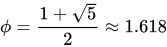
Almost integers relating to the golden ratio and Fibonacci numbers [ edit ] Some examples of almost integers are high powers of the golden ratio
ϕ
=
1
+
5
2
≈
1.618
{\displaystyle \phi ={\frac {1+{\sqrt {5}}}{2}}\approx 1.618}
ϕ
17
=
3571
+
1597
5
2
≈
3571.00028
ϕ
18
=
2889
+
1292
5
≈
5777.999827
ϕ
19
=
9349
+
4181
5
2
≈
9349.000107
{\displaystyle {\begin{aligned}\phi ^{17}&={\frac {3571+1597{\sqrt {5}}}{2}}\approx 3571.00028\\[6pt]\phi ^{18}&=2889+1292{\sqrt {5}}\approx 5777.999827\\[6pt]\phi ^{19}&={\frac {9349+4181{\sqrt {5}}}{2}}\approx 9349.000107\end{aligned}}}
The fact that these powers approach integers is non-coincidental, because the golden ratio is a Pisot–Vijayaraghavan number .
The ratios of Fibonacci or Lucas numbers can also make almost integers, for instance:
Fib
(
360
)
Fib
(
216
)
≈
1242282009792667284144565908481.999999999999999999999999999999195
{\displaystyle {\frac {\operatorname {Fib} (360)}{\operatorname {Fib} (216)}}\approx 1242282009792667284144565908481.999999999999999999999999999999195}
Lucas
(
361
)
Lucas
(
216
)
≈
2010054515457065378082322433761.000000000000000000000000000000497
{\displaystyle {\frac {\operatorname {Lucas} (361)}{\operatorname {Lucas} (216)}}\approx 2010054515457065378082322433761.000000000000000000000000000000497}
The above examples can be generalized by the following sequences, which generate near-integers approaching Lucas numbers with increasing precision:
a
(
n
)
=
Fib
(
45
×
2
n
)
Fib
(
27
×
2
n
)
≈
Lucas
(
18
×
2
n
)
{\displaystyle a(n)={\frac {\operatorname {Fib} (45\times 2^{n})}{\operatorname {Fib} (27\times 2^{n})}}\approx \operatorname {Lucas} (18\times 2^{n})}
a
(
n
)
=
Lucas
(
45
×
2
n
+
1
)
Lucas
(
27
×
2
n
)
≈
Lucas
(
18
×
2
n
+
1
)
{\displaystyle a(n)={\frac {\operatorname {Lucas} (45\times 2^{n}+1)}{\operatorname {Lucas} (27\times 2^{n})}}\approx \operatorname {Lucas} (18\times 2^{n}+1)}
As n increases, the number of consecutive nines or zeros beginning at the tenths place of a (n ) approaches infinity.
e and π [ edit ] Other occurrences of non-coincidental near-integers involve the three largest Heegner numbers :
e
π
43
0
≈
000
00000
0
8847
36743.99977
7466
{\displaystyle e^{\pi {\sqrt {43{\phantom {0}}}}}\approx \;{\phantom {000\,00000\,0}}8847\,36743.99977\,7466}
e
π
67
0
≈
000
000
14
71979
52743.99999
86624
54
{\displaystyle e^{\pi {\sqrt {67{\phantom {0}}}}}\approx \;{\phantom {000\,000}}14\,71979\,52743.99999\,86624\,54}
e
π
163
≈
262
53741
26407
68743.99999
99999
99250
07
{\displaystyle e^{\pi {\sqrt {163}}}\approx \;262\,53741\,26407\,68743.99999\,99999\,99250\,07}
where the non-coincidence can be better appreciated when expressed in the common simple form:[ 2]
e
π
43
0
=
12
3
(
00
9
2
−
1
)
3
+
744
−
2.225
…
⋅
10
−
4
{\displaystyle e^{\pi {\sqrt {43{\phantom {0}}}}}=12^{3}({\phantom {00}}9^{2}-1)^{3}+744\ -\ 2.225\ldots \cdot 10^{-4}}
e
π
67
0
=
12
3
(
0
21
2
−
1
)
3
+
744
−
1.337
…
⋅
10
−
6
{\displaystyle e^{\pi {\sqrt {67{\phantom {0}}}}}=12^{3}({\phantom {0}}21^{2}-1)^{3}+744\ -\ 1.337\ldots \cdot 10^{-6}}
e
π
163
=
12
3
(
231
2
−
1
)
3
+
744
−
7.499
…
⋅
10
−
13
{\displaystyle e^{\pi {\sqrt {163}}}=12^{3}(231^{2}-1)^{3}+744\ -\ 7.499\ldots \cdot 10^{-13}}
where
21
=
3
⋅
7
,
231
=
3
⋅
7
⋅
11
,
744
=
24
⋅
31
{\displaystyle 21=3\cdot 7,\quad 231=3\cdot 7\cdot 11,\quad 744=24\cdot 31}
and the reason for the squares is due to certain Eisenstein series . The constant
e
π
163
{\displaystyle e^{\pi {\sqrt {163}}}}
Ramanujan's constant .
Almost integers that involve the mathematical constants π e have often puzzled mathematicians. An example is:
e
π
−
π
=
19.99909
99791
89
…
{\displaystyle e^{\pi }-\pi =19.99909\,99791\,89\ldots }
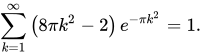
Jacobi theta functions as follows:
∑
k
=
1
∞
(
8
π
k
2
−
2
)
e
−
π
k
2
=
1.
{\displaystyle \sum _{k=1}^{\infty }\left(8\pi k^{2}-2\right)e^{-\pi k^{2}}=1.}
k
≥
2
{\displaystyle k\geq 2}
∼
0.00034
36.
{\displaystyle \sim 0.00034\,36.}
(
8
π
−
2
)
e
−
π
≈
1
,
{\displaystyle \left(8\pi -2\right)e^{-\pi }\approx 1,}
e
π
{\displaystyle e^{\pi }}
e
π
≈
8
π
−
2.
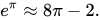
{\displaystyle e^{\pi }\approx 8\pi -2.}
e
π
{\displaystyle e^{\pi }}
7
π
≈
22
{\displaystyle 7\pi \approx 22}
e
π
≈
π
+
7
π
−
2
≈
π
+
22
−
2
=
π
+
20.
{\displaystyle e^{\pi }\approx \pi +7\pi -2\approx \pi +22-2=\pi +20.}
e
π
−
π
≈
20.
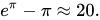
{\displaystyle e^{\pi }-\pi \approx 20.}
7
π
{\displaystyle 7\pi }
[ 1]
Another example involving these constants is:
e
+
π
+
e
π
+
e
π
+
π
e
=
59.99945
90558
…
{\displaystyle e+\pi +e\pi +e^{\pi }+\pi ^{e}=59.99945\,90558\ldots }





![{\displaystyle {\begin{aligned}\phi ^{17}&={\frac {3571+1597{\sqrt {5}}}{2}}\approx 3571.00028\\[6pt]\phi ^{18}&=2889+1292{\sqrt {5}}\approx 5777.999827\\[6pt]\phi ^{19}&={\frac {9349+4181{\sqrt {5}}}{2}}\approx 9349.000107\end{aligned}}}](https://wikimedia.org/api/rest_v1/media/math/render/svg/517ac892a0426835ff7e4378faf421aeef1d9fdd)