


Continuous positive airway pressure
| Continuous positive airway pressure | |
|---|---|
 Equipment for CPAP therapy: flow generator, hose, mask | |
| Pronunciation | The abbreviation CPAP is commonly pronounced "see-pap" |
| Uses | Treatment of obstructive sleep apnea and/or acute decompensated heart failure and/or COVID-19 |


Continuous positive airway pressure (or CPAP) is the name of a therapy. The idea is that when they sleep, people wear a mask on their face. A machine generates an atmospheric pressure that is higher than the sourroundings. This will push air into people's lungs when they breathe. This kind of therapy is often used to treat conditions such as sleep apnea or chronic obstructive pulmonary disease. In this version, people still breathe on ther own, the machine simply helps them. There are versions of this therapy for intensive care and emergency medicine where the mask is replaced by tracheal intubation.
CPAP therapy is very effective for managing obstructive sleep apnea.[1] Compliance and acceptance of use of CPAP therapy can be a limiting factor, with 8% of people stopping use after the first night and 50% within the first year.[2] For treatment of chronic conditions such as obstructive sleep apnea, CPAP needs to be used for all sleep, including naps and travel away from home.
- How it works
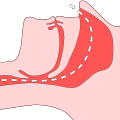 Normal breathing without obstruction
 An obstruction makes breathing difficult
 Pressure raises the back of the tongue, and removes the obstruction


Different masks
[change | change source]
There are different ways to deliver the air:
- A nasal mask or nasal prong: These only cover the nose, and leave the mouth free. They are the most common form of mask used for CPAP.[3] There are also nasal pillow masks which have a cushion at the base of the nostrils, and are considered the least invasive option.[4] They are often used for infants.
- A nasopharyngal CPAP uses a tube to deliver the air. It bypasses the nose, and delivers air directly into the upper respiratory system. It is the most invasive optio.
- A full face mask covers the nouse and the mouth, and usually is airtight. It needs a system to get rid of the used air.
References
[change | change source]- ↑ Brown, Olivia (2025-02-26). "What Is Sleep Apnea?". CPAP.com. Archived from the original on 2025-02-20. Retrieved 2021-05-11.
- ↑ Askland, Kathleen; Wright, Lauren; Wozniak, Dariusz R.; Emmanuel, Talia; Caston, Jessica; Smith, Ian (April 2020). "Educational, supportive and behavioural interventions to improve usage of continuous positive airway pressure machines in adults with obstructive sleep apnoea". The Cochrane Database of Systematic Reviews. 2020 (4) CD007736. doi:10.1002/14651858.cd007736.pub3. ISSN 1469-493X. PMC 7137251. PMID 32255210.
- ↑ Pinto, Venessa L.; Sharma, Sandeep (2020), "Continuous Positive Airway Pressure (CPAP)", StatPearls, Treasure Island (FL): StatPearls Publishing, PMID 29489216, archived from the original on 2020-11-11, retrieved 2020-09-02
- ↑ "Slide show: Which CPAP masks are best for you?". Mayo Clinic. Archived from the original on 2021-05-11. Retrieved 2021-05-11.