


Giovanni I Chiaramonte
Giovanni I Chiaramonte | |
|---|---|
 Chiaramonte coat of arms | |
| Born | c. 1270s[a] Sicily (probably Girgenti/Agrigento) |
| Died | 1339 |
| Spouse |
|
| Issue |
|
| Father | Federico Chiaramonte |
| Mother | Marchisia Profoglio (Prefoglio) |
Giovanni I Chiaramonte[b] (c. 1270s[a]–1339), also known as il Vecchio (“the Elder”), was a Sicilian nobleman of the Chiaramonte family and the younger brother of Manfredi I Chiaramonte. A supporter of Frederick III of Sicily during the War of the Sicilian Vespers, he distinguished himself in the defence of Syracuse (1298–99) and Palermo (1325), and in 1307 began construction of the fortified Palazzo Chiaramonte-Steri, establishing the family’s seat and power base in the capital.
Origins and family
[edit]Giovanni was the son of Federico Chiaramonte and Marchisia Profoglio[b] and the younger brother of Manfredi I Chiaramonte.[3] He was born in Sicily after the mid-13th century, into a family already established on the island through Profoglio inheritances around Girgenti (Agrigento); in 1299 Marchisia is recorded founding and endowing a Cistercian house there.[3]
Claims that the Chiaramonte descended from the French Clermonts remain unproven; modern reference works treat the connection as possible but uncertain.[2]
Giovanni had at least two brothers, Manfredi I and Federico.[3] By the early 1300s a partition of the family estates is attested: Giovanni held Favara, Comiso and Mussaro[c] (acquired in 1305 in exchange for Margidiramo); Federico held Racalmuto and Siculiana; while Manfredi had received Caccamo from his mother Marchisia (d. c. 1300) and later added the County of Modica with Ragusa and Scicli (1296).[3]
Career
[edit]Note: After the Sicilian Vespers (1282) Sicily and Naples were ruled by rival dynasties.
Sicily (Aragonese line):
- Peter I of Sicily (r. 1282–1285) — also king of Aragon as Peter III
- James I of Sicily (r. 1285–1291) — later ceded Sicily by the Treaty of Anagni
- Frederick III (r. 1296–1337)
Naples (Angevin line):
- Charles I of Anjou (r. 1266–1285)
- Charles II (r. 1285–1309)
- Robert of Anjou (r. 1309–1343)
Aragon (Crown of Aragon; external but decisive):
- Peter III of Aragon (r. 1276–1285)
- Alfonso III of Aragon (r. 1285–1291)
- James II of Aragon (r. 1291–1327)
Background
[edit]The Sicilian Vespers revolt of 1282 expelled Angevin (French/Neapolitan) forces from the island and brought in the Aragonese dynasty. The old kingdom split: the island (“Kingdom of Sicily” or “Trinacria”) was ruled by the Aragonese, while the mainland (“Kingdom of Naples”) remained Angevin.
Early military service
[edit]Giovanni I first appears in the record as a supporter of King Frederick III of Aragon during the renewed conflict with the Angevins in the 1290s. In 1298–99 he commanded the defence of Syracuse, where he uncovered and crushed a conspiracy inside the city to surrender it to Angevin forces, keeping Syracuse loyal to the crown through the siege.[3] On 14 June 1300 he took part in the naval battle off Ponza, where the Sicilian fleet under Doria Lancia was defeated by the Angevin admiral Roger of Lauria; Giovanni was captured and taken prisoner.[3] He was back in royal service by 1302, when he directed the defence of Caccamo against the forces of Charles of Valois.[3]
Giovanni’s conduct in these operations earned him sustained royal favour: his positions and holdings were confirmed, and his standing at court rose, paving the way for his later acquisition of a palatial site in Palermo (1307) and for high civic and royal offices there (attested 1317).[3]
Palermo and the Steri
[edit]In 1307 Giovanni purchased a large site in the Kalsa, the historic Arab-founded quarter of Palermo close to the harbour, and began construction of the family’s fortified palace, later known as the Palazzo Chiaramonte-Steri.[3] From this base his authority in the capital consolidated: by 1317 he is attested as captain and justiciar of Palermo, styled in royal documents as caput civitatis ("head of the city").[3]
Operating from Palermo, Giovanni also took on wider military responsibilities. A planned naval expedition of 1314 was aborted by storms; in 1325 he successfully organised the city’s defence against a major Angevin fleet led by the duke of Calabria, and in 1328 he commanded a naval operation in support of Emperor Louis IV.[3]
Head of family and royal offices
[edit]On the death of his elder brother Manfredi I Chiaramonte (c. 1321), Giovanni became head of the Chiaramonte family. He inherited the role of family spokesman at court and took up some of the kingdom’s highest offices, serving in turn as grand seneschal, procurator general and maestro razionale (chief financial officer) of the realm.[3]
As head of the dynasty he also mediated in baronial politics. In 1332 he arbitrated a dispute between his nephew Giovanni II Chiaramonte, Count of Modica, and Francesco I Ventimiglia, count of Geraci.[3] During Giovanni II’s exile from court (1335–1337), the county of Modica was temporarily granted to Giovanni’s son Manfredi II Chiaramonte, and after Giovanni II’s death in 1342 it passed permanently to that branch of the family.[3]
Patronage
[edit]Giovanni’s most enduring work of patronage was the Palazzo Chiaramonte-Steri in Palermo. Begun in 1307 on a vast site he acquired in the Kalsa quarter, the palace was both a fortified residence and a statement of Chiaramonte power, establishing the dynasty’s permanent seat in the capital.[3] Its design, with massive rusticated walls and mullioned windows on the piano nobile, became a model for later works in the Chiaramontan Gothic style.[4][5][6]
Family life
[edit]Giovanni married Lucca Palizzi, daughter of Niccolò Palizzi "il Vecchio", linking the Chiaramonte to one of the kingdom’s leading baronial networks.[3] The marriage was in place by 1311, when their son is recorded as Manfreduccio in a family testament; the couple’s sons included Manfredi II, Enrico (later maestro razionale), Federico, and Giacomo.[3][7] Through this alliance Giovanni participated in Palizzi ecclesiastical and civic patronage networks; Lucca’s memory is preserved by a tomb originally at Santa Maria della Catena, Palermo (now Antonino Salinas Regional Archaeological Museum).[8]
Death and succession
[edit]Giovanni I died at Palermo in 1339.[3] The leadership of the family passed to his sons, notably Manfredi II Chiaramonte, while the County of Modica—on his nephew Giovanni II Chiaramonte’s death in 1347—devolved to Manfredi II under earlier testamentary provisions.[3]
Gallery
[edit]-
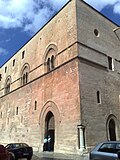 Palazzo Chiaramonte-Steri, begun by Giovanni I in 1307.
 -
 Antonino Salinas Regional Archaeological Museum, Palermo (Lucca Palizzi’s tomb).
 -
 Ponza, site of the naval battle on 14 June 1300; Giovanni I was captured after the Sicilian defeat.
 -
 Succession of the Counts of Modica.


Notes
[edit]- ^ a b No record of Giovanni’s birth survives. Treccani places it “after the mid-13th century”; given his command roles in 1298–1300, a date in the 1260s–early 1270s is plausible.[3]
- ^ a b Contemporary and later sources vary the spelling of the family name as Chiaramonte/Chiaromonte; his mother's surname appears as Profoglio/Prefoglio. Modern Italian reference works (Treccani) standardise on Chiaramonte and attest both maternal forms.[1][2]
- ^ Mussaro is generally identified with present-day Sant'Angelo Muxaro (AG). Margidiramo/Margidirami was a casale in the territory of modern Porto Empedocle; in 1305 Giovanni exchanged it with the Church of Agrigento for Mussaro.
References
[edit]- ^ Walter, Ingeborg (1980). "Chiaramonte, Manfredi (il Vecchio), conte di Modica". Dizionario Biografico degli Italiani. Vol. 24. Treccani.
- ^ a b "Chiaramonte". Dizionario di Storia. Treccani.
- ^ a b c d e f g h i j k l m n o p q r s t Walter, Ingeborg (1980). "Chiaramonte, Giovanni, il Vecchio". Dizionario Biografico degli Italiani (in Italian). Vol. 24. Treccani. Retrieved 19 October 2025.
- ^ Spatrisano, Giuseppe (1972). Lo Steri di Palermo e l'architettura siciliana del Trecento. Palermo: S. F. Flaccovio.
- ^ "Palermo". Enciclopedia dell’Arte Medievale (in Italian). Treccani. Retrieved 19 October 2025.
- ^ Gàbrici, Ettore; Ezio Levi (1993). Lo Steri di Palermo e le sue pitture (reprint ed.). Treves.
- ^ "Chiaramonte, Manfredi, conte di Modica". Dizionario Biografico degli Italiani (in Italian). Treccani. 1980. Retrieved 19 October 2025.
- ^ Sardina, Patrizia (2022). "I Chiaromonte tra Ventimiglia e Palizzi: legami politici e cultura materiale" (PDF). Mediterranea. Ricerche storiche (in Italian). 19. Retrieved 19 October 2025.