


Operator monotone function
In linear algebra, operator monotone functions are an important type of real-valued function, fully classified by Charles Löwner in 1934.[1] They are closely related to operator concave and operator convex functions, and are encountered in operator theory and in matrix theory, and led to the Löwner–Heinz inequality.[2][3] Operator monotone functions are called in other contexts complete Bernstein function, Nevanlinna function, Pick function or class (S) function.[4]
Definition
[edit]A function defined on an interval is said to be operator monotone if whenever and are Hermitian matrices (of any size/dimensions) whose eigenvalues all belong to the domain of and whose difference is a positive semi-definite matrix, then necessarily where and are the values of the matrix function induced by (which are matrices of the same size as and ). The function is said to be n-matrix monotone (or just n-monotone) if the above holds for any matrices and of size (but not necessarily of other sizes).





Notation
This definition is frequently expressed with the notation that is now defined.
Write to indicate that a matrix is positive semi-definite and write to indicate that the difference of two matrices and satisfies (that is, is positive semi-definite).


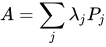
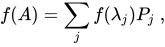
With and as in the theorem's statement, the value of the matrix function is the matrix (of the same size as ) defined in terms of its 's spectral decomposition by where the are the eigenvalues of with corresponding projectors


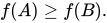
The definition of an operator monotone function may now be restated as:
A function defined on an interval said to be operator monotone if (and only if) for all positive integers and all Hermitian matrices and with eigenvalues in if then


Löwner’s theorem on holomorphic extension
[edit]Löwner’s theorem[1] states that a function is operator monotone if and only if it allows an analytic continuation to the upper half-plane with non-negative imaginary part.
More generally, a function for is operator monotone if and only if it extends to a holomorphic function on such that


![{\displaystyle \mathbb {C} \setminus (-\infty ,0]}](https://wikimedia.org/api/rest_v1/media/math/render/svg/176aa07911a31b95347623fb4234598c736029eb)

which can be summarized as .

Relation to Bernstein functions
[edit]Operator monotone functions are a special type of Bernstein function. If we write the Bernstein representation of the Bernstein function asthen is operator monotone if and only if the measure has a density function and this function is completely monotone, which explains why such a function is also called a complete Bernstein function.


See also
[edit]- Matrix function – Function that maps matrices to matrices
- Trace inequality – Concept in Hlibert spaces mathematics
References
[edit]- ^ a b Löwner, K.T. (1934). "Über monotone Matrixfunktionen". Mathematische Zeitschrift. 38: 177–216. doi:10.1007/BF01170633. S2CID 121439134.
- ^ "Löwner–Heinz inequality". Encyclopedia of Mathematics.
- ^ Chansangiam, Pattrawut (2013). "Operator Monotone Functions: Characterizations and Integral Representations". arXiv:1305.2471 [math.FA].
- ^ Schilling, R.; Song, R.; Vondraček, Z. (2010), Bernstein functions. Theory and Applications, Studies in Mathematics, vol. 37, de Gruyter, Berlin, doi:10.1515/9783110215311, ISBN 9783110215311
Further reading
[edit]- Hansen, Frank (2013). "The fast track to Löwner's theorem". Linear Algebra and Its Applications. 438 (11): 4557–4571. arXiv:1112.0098. doi:10.1016/j.laa.2013.01.022. S2CID 119607318.
- Chansangiam, Pattrawut (2015). "A Survey on Operator Monotonicity, Operator Convexity, and Operator Means". International Journal of Analysis. 2015: 1–8. doi:10.1155/2015/649839.
- Boţ, Radu Ioan; Csetnek, Ernö Robert; Hendrich, Christopher (1 April 2015). "Inertial Douglas–Rachford splitting for monotone inclusion problems". Applied Mathematics and Computation. 256: 472–487. doi:10.1016/j.amc.2015.01.017.
 | This linear algebra-related article is a stub. You can help Wikipedia by adding missing information. |