


Talk:Graph product
 | This article is rated Start-class on Wikipedia's content assessment scale. It is of interest to the following WikiProjects: | ||||||||||
| |||||||||||


Dimensions
[edit]What is the meaning of the "dimensions" column? I thought it might tell how many edges there are in the product graph, but this appears to not be the case. Dstahlke (talk) 23:55, 1 April 2014 (UTC)
It does. For example,

means that you take a graph G with V1 vertices and E1 edges, and a graph H with V2 vertices and E2 edges, and get a product with V1.V2 vertices and E2.V1+E1.V2 edges. Maproom (talk) 06:29, 2 April 2014 (UTC)
- This really needs to be explained in the article itself. 130.243.68.6 (talk) 16:01, 19 October 2017 (UTC)
Direct product of graphs
[edit]Rather confusing, the term direct product of graphs is used inconsistently in the literature for several types of products. In Grimmett and Newman 1990, for example, they use the term direct product and the notation for the Cartesian product as it is defined in this page. In Brešar and Špacapan 2008, on the other hand, the term direct product, with the notation , is used for the Tensor product as it is defined here.

Note that in the article about the tensor product of graphs, it is mentioned that it is sometimes called direct product. It is not mentioned in the article about the Cartesian product.
Should we add a relevant note in this page? Peleg (talk) 11:15, 30 April 2017 (UTC)
Number of edges
[edit]The formulas for the numbers of edges are not correct in the presence of self-loops. For example, the tensor product with a single-vertex graph that has a self-loop gives back the original graph. I didn't want to edit this because I might introduce inconsistencies. 130.226.132.10 (talk) 08:34, 8 May 2023 (UTC)
- I added a note saying that the formulas may not hold in the presence of self-loops, also that in general literature is less consistent on the definitions when self-loops are in play. Amending the formulas to work when self-loops are present could get kind of messy quickly and I think it might be best (for now?) to leave it under the simple graph assumption, with appropriate disclaimers. I'm not confident, but I think that if you make a policy of counting self-loops as only counting as "half an edge" -- which is a trick I've seen before somewhere -- then the formulas might mostly work still. Timeroot (talk) 14:23, 28 August 2023 (UTC)
Corona product
[edit]@BagLuke: I now remove the corona product from the list (thus undoing one of your edits), on the ground that it does not satisfy the first condition which this article now states for graph products. The vertex set of the corona product is not equal to the cartesian product , but somewhat larger; rather, we get

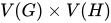
- ;

right?
This is surely the reason @Altenmann already when introducing the corona product to Graph operations classified it as not based on the cartesian product.
Now, this contains the cartesian product, and essentially is the cartesian product of and the vertex set of the disjoint union of H and . Thus, you may argue that the corona product is 'almost' a graph product in the sense given in this article; but it is not satisfying the definition as it stands. (If you want to put back the corona product, then you either have to amend the article general definition of 'graph product' (which I do not recommend, without first asking the opinion of others); or add the corona product after the list proper, with some kind of see also or an example of a binary graph operation not quite satisfying the definition comment. Or, we could simply add some text somewhere stating that also some other graph operations sometimes are called graph products, with either just a link, or with a short list of examples.) Regards, JoergenB (talk) 13:34, 12 November 2025 (UTC)

