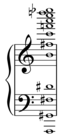
Upper structure
In jazz, the term upper structure or "upper structure triad" refers to a voicing approach developed by jazz pianists and arrangers defined by the sounding of a major or minor triad in the uppermost pitches of a more complex harmony.[1]
Examples
[edit]Example 1
[edit]Below, a common voicing used by jazz pianists is given for the chord C7♯9. Note that the root C is omitted here, and is often done so by jazz pianists for ease of playing, or because a bass player is present.

In the lower staff, the notes E and B♭ are given, forming a tritone which defines the dominant sound and are the major third and minor seventh of the C7♯9 chord. In the upper staff, the notes E♭, G, and B♭ are given together, which form an E♭ major triad. This E♭ major triad is what would be called the upper structure. Considered in relation to the root C, the notes of this E♭ major-triad function, respectively, as the sharp ninth (the root of the E♭ major chord), fifth, and seventh in relation to that root.
Example 2
[edit]The following example illustrates the notes of an F♯ minor triad functioning as part of a C13♭9♯11 chord :

In relation to the root of C, the C♯ (enharmonic with D♭) functions as the minor ninth, the F♯ as the augmented eleventh, and the A as the major thirteenth, respectively.
Application
[edit]Determining which additional pitches can be juxtaposed with the chord is achieved by considering the relationship between a particular chord and the scale it implies. An example follows:
- The chord C13♭9♯11 contains the following notes, from the root upwards: C, E, G, B♭, D♭, F♯, A;
- The following diminished scale contains all of these pitches, and fits/matches up with the C13♭9♯11 chord: C–D♭–D♯–E–F♯–G–A–B♭–C; these scale elements form a pool from which melodic and harmonic devices might be devised.
Shorthand notation
[edit]Common jazz parlance refers to upper structures by way of the interval between the root of the bottom chord and the root of the triad juxtaposed above it.[2] For instance, in example one above (C7♯9) the triad of E♭ major is a (compound) minor 3rd away from C (root of the bottom chord). Thus, this upper structure can be called upper structure flat three, or US♭III for short.
Other possible upper structures are:
- USII – e.g. D major over C7, resulting in C13♯11
- US♭V – e.g. G♭ major over C7, resulting in C7♭9♯11
- US♭VI – e.g. A♭ major over C7, resulting in C7♯9♭13
- USVI – e.g. A major over C7, resulting in C13♭9
- USi – e.g. C minor over C7, resulting in C7♯9
- US♭ii – e.g. D♭ minor over C7, resulting in C7♭9♭13
- US♭iii – e.g. E♭ minor over C7, resulting in C7♯9♯11
The second item in the list above (C7♭9♯11) has a related version called upper structure sharp four minor--with the written shorthand US♯iv--created with an F♯ minor triad. (See "Example 2" above.)