


Dolphin
| Dolphin | |
|---|---|
 | |
| A bottlenose dolphin, the most well known type of dolphin. | |
Scientific classification | |
| Kingdom: | Animalia |
| Phylum: | Chordata |
| Class: | Mammalia |
| Order: | Artiodactyla |
| Infraorder: | Cetacea |
| Parvorder: | Odontoceti |
| Groups included | |
| Cladistically included but traditionally excluded taxa | |
Dolphins are part of the toothed whales. Generally, they are among the smaller whales. Most live in salt water oceans, but there are also river dolphins. They are mammals, not fish.[1]
Dolphins are usually between 1.5 metres (4.9 ft) and 4 metres (13 ft) long. In comparison, the largest dolphin, the orca (killer whale), can be up to 8 metres (26 ft) long.
Name
[change | change source]The dolphin was first thought to be a fish with a womb. For this reason, it was named "dolphin," which comes from the Ancient Greek word δελφίς (delphis), meaning "with a womb". Today, though, dolphins are known to be highly intelligent mammals, not fish.[1]
Description
[change | change source]Dolphins breathe air. A dolphin's nose is on top of its head so the dolphin can easily breathe on the surface of the water.
The skin of a dolphin is gray, smooth, soft, and rubbery. It has no scales. It is very firm, because dolphins are very muscular.
Social animals
[change | change source]All dolphins live in groups called "pods". They are social animals at all stages of their lives. Pods travel together, hunt together and defend each other.[2] Dolphins have fought off sharks by ramming them over and over again with their snouts and heads.
Sharks look after the young when the mothers need to leave their calves to hunt for food. The young need to breathe more often than the adults, and the food may be in deeper waters.
Dolphins "porpoise" in and out of the water when traveling at high speed. Scientists do not know for sure why they do this. It may be the fastest movement they are capable of.[3]
Diet
[change | change source]Dolphins are carnivores and eat fish. They use echolocation to find their food.
When they chase fish, the fish go into a "bait ball" to self-protect. In turn, the dolphins attack in a group and eat as many fish as they can.
Habitat
[change | change source]Oceanic dolphins are marine animals living in the sea. They live in all of the oceans.
Three of the four species of river dolphins live in fresh water rivers. The La Plata dolphin lives in saltwater estuaries and the ocean. Water pollution and the loss of habitat are a threat to some dolphins, especially those living in rivers and estuaries.
Sleep
[change | change source]Dolphins (and other cetaceans) sleep in the water.[4] There is danger from animals that eat dolphins.[5] To guard against danger from animals that eat dolphins, they have two sides of their brain. One side sleeps, while the other side stays awake.
Dolphins do things while asleep:
- Dolphins will keep one eye open to watch for animals that eat them while they sleep.
- Dolphins also swim in circles when they are sleeping to look around for danger.
- Dolphins get their nose out of the water to breathe.
Dolphin groups or species have their own way of sleeping. Pinnipeds, like seals, can sleep like dolphins.[4]
Senses
[change | change source]The brain of a dolphin is like a human brain in size and development. Dolphins have reasonable eyesight. They can watch a thing in the water, and they can see colors, too. They can also see in dark places.
A dolphin's hearing is better than their sight. Small holes behind the eyes are the dolphin's ears. Dolphins can hear a sound underwater. They can know the direction of the sound very well and use echolocation to hunt.
Dolphins and humans
[change | change source]Mythology
[change | change source]
Dolphins have long played a role in human culture. They are common in Greek mythology, and there are many coins from ancient Greece which feature a man, boy, or deity riding on the back of a dolphin.[6] The Ancient Greeks welcomed dolphins; spotting dolphins riding in a ship’s wake was considered a good omen.[7]
In Hindu mythology, the Ganges River Dolphin is associated with Ganga, the deity of the Ganges River.
Cuisine
[change | change source]
Dolphin meat is eaten in a few countries, including Japan[8] and Peru (where it is referred to as chancho marino, or "sea pork"). Japan may be the best-known and most controversial example, but worldwide, eating dolphin is not common.
Dolphin therapy
[change | change source]Dolphin therapy is sometimes used for people with mental or physical disabilities. It involves contact with trained dolphins.
Scientists do not agreed on whether dolphin therapy is any better than the usual treatments.[9] Scientists continue to study this treatment method.
Taxonomy
[change | change source]Oceanic dolphins (Delphinidae)
[change | change source]Some examples:
- Genus Delphinus
- Common Dolphin (Delphinus delphis)
- Genus Tursiops
- Bottlenose Dolphin (Tursiops truncatus)
- Genus Orcinus
- Orca (Orcinus orca)
- Genus Feresa
- Pygmy killer whale Feresa attenuata
- Genus Pseudorca
- False killer whale Pseudorca crassidens
- Genus Globicephala
- Long-finned pilot whale Globicephala melas
- Short-finned pilot whale Globicephala macrorhynchus
- Genus Peponocephala
- Melon-headed whale Peponocephala electra
River dolphins
[change | change source]- Amazon river dolphin or Boto (Inia geoffrensis)
- Chinese river dolphin or Baiji (Lipotes vexillifer) (likely to be extinct)
- La Plata dolphin (Pontoporia blainvillei)
- South Asian river dolphin Platanista gangetica
- Indus river dolphin (Platanista gangetica minor)
- Ganges river dolphin (Platanista gangetica gangetica)
Gallery
[change | change source]


 A dead dolphin
 Bottlenose dolphin (Tursiops truncatus)
 KDog, a common bottlenose dolphin of the United States Navy Marine Mammal Program. Here he is shown wearing a locating pinger in the Persian Gulf.
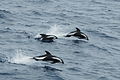 Hourglass dolphins (Lagenorhynchus cruciger) leaping in the Drake Passage


.png?lang=simple)


References
[change | change source]
- 1 2 US Department of Commerce, National Oceanic and Atmospheric Administration. "Are dolphins fish?". oceanservice.noaa.gov. Retrieved September 29, 2025.
- ↑ "Bottlenose Dolphin Pod | Smithsonian Ocean". ocean.si.edu. Retrieved September 29, 2025.
- ↑ BBC footage of dophins at top speed.
- 1 2 Lyamin et al 2004. Relationship between sleep and eye movement in cetaceans and pinnipeds. Archives Italliennes de Biologie 142: 557–568.
- ↑ Gill, Victoria 2012. Slowest Greenland shark hunts sleeping prey. BBC Nature Archived 2012-06-22 at Archive-It
- ↑ "Taras". Archived from the original on February 8, 2007. Retrieved October 3, 2010.
- ↑ Eyers, Jonathan 2011. Don't shoot the Albatross!: nautical myths and superstitions. A&C Black, London, UK. ISBN 978-1-4081-3131-2
- ↑ McCurry, Justin (2009). "Dolphin slaughter turns sea red as Japan hunting season returns". The Guardian. London. Retrieved May 24, 2010.
- ↑ Lori Marino, Scott O. Lilienfeld (2007). "Dolphin-Assisted Therapy: more flawed data and more flawed conclusions" (PDF). Anthrozoos. 20 (3): 239–49. doi:10.2752/089279307X224782. ISSN 0892-7936. S2CID 6119940. Archived from the original (PDF) on February 28, 2008. Retrieved February 20, 2008.
Other websites
[change | change source]- https://www.fisheries.noaa.gov/species/common-bottlenose-dolphin
- https://uk.whales.org/whales-dolphins/facts-about-dolphins/
| Poultry |   | |
|---|---|---|
| Livestock | ||
| Game | ||
| Fish | ||
| Shellfish and other seafood | ||
| Insects | ||
| Cuts and preparation | ||
| List articles | ||
| Related subjects | ||
